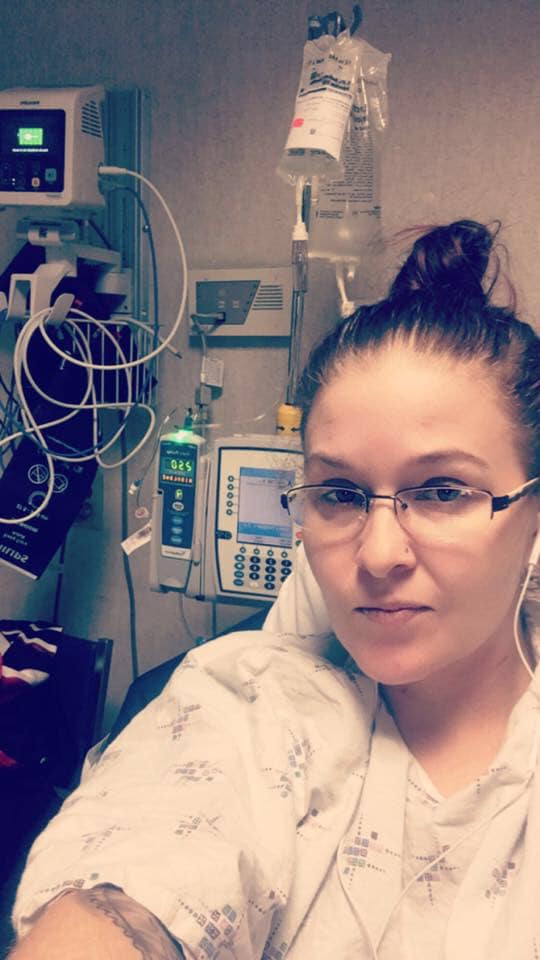
 When I first started getting hit with symptoms, I was a divorced, single mother of three amazing kids; responsible not only to provide for them but to see them through life, unscathed by life’s situations, and showing them that there was nothing that if they worked hard at something, nothing could hold them back. I had just started to expand in my career as a self-taught auto technician. I was a woman making a place for herself in an industry traditionally dominated by males. July 3, 2015, was the day that my life forever changed. I was brought to the hospital with stroke-like symptoms. I was having visual problems. I couldn’t walk or talk. I had no idea who I was or where I was. The whole right side of my body basically stopped working and the right side of my face was droopy. I was brought to the ER and before the doctor would even try to figure out what was wrong with me, he ordered a series of drug tests. I passed every test, so he finally admitted to me. Once on the neurology floor, more testing was done. They performed an MRI, MRA, EKG and told us that all results were normal. I later discovered that was not the case.
One doctor refused to believe that I was not on drugs. She noted in my file that while she has no evidence to support it, she believed that I am on a drug that they hadn’t screened for, based solely on “my age, single mom status, and prior good health.” She also noted that they found a Chiari, but that based on my symptoms, she believed it was irrelevant (an incidental finding). I would love to see her now and show her just how very wrong she was. I firmly believe that what she put in my medical chart is why I have had such a difficult time getting the care that I need and deserve.
 A few days later, I followed up with my PCP. She went over my MRI results with me and pointed out that they found a Chiari Malformation with a 19mm herniation of my cerebellar tonsils. She told me of changes in my white matter that the radiologist said needed to be “further evaluated” and referred me to my first neurologist, who I met within August. He ordered a visual evoked potential and an EEG. Both come back normal, so he diagnosed me with migraines, even after hearing my symptoms, which frustrates me even more as I know that it is not migraines causing these issues.
At this point, I switched my neurology care to another hospital. They went over my history with me and ordered a lumbar puncture to rule out Multiple Sclerosis, which showed banding in my spinal fluid. On September 14, 2015, I was officially diagnosed with Multiple Sclerosis and opted to begin treatment and was to start on Plegridy. As I started the full doses I started breaking out into hives. The docs didn’t seem to think I should worry, so I called the drug manufacturer and they said it should be considered an allergic reaction to the Plegridy, and to discontinue using it and advise my doctor.
After this experience, I switched care back to the first hospital for neurology to get a second opinion. The new neurologist ordered a new brain MRI and one of my cervical spine. There were no changes to my brain MRI, but my cervical imaging showed a syrinx. They weren’t sure if the syrinx was of any significance. So, she referred me to the only MS specialist in North Dakota whom I would meet with, in May. The MS specialist took a complete history on me and ran a bunch of blood work to rule out other illnesses. When those illnesses were all ruled out, she diagnosed me with Radiologic Isolated Syndrome (which means that they saw similar characteristics to MS in my imaging, without MS symptoms). While in her care I continued to get worse, with symptoms progressed to include pins and needles feeling in my hands and feet, occipital headaches that drop me to the ground, cognitive decline, fatigue, weakness, some random numbness, and muscle spasms. She ordered a new MRI and once again no changes were indicated. She began to question if my Chiari was behind my growing number of symptoms. She tried to refer me to Mayo, but my insurance declined her referral.
Eventually, I started having issues walking and my gait was becoming increasingly unsteady, so I return to a local neurology clinic. They did an MRI on my brain, cervical and thoracic spine. They found a syrinx in my thoracic spine and once again they doubted the significance, along with a slight scoliosis convex. When asked what a syrinx was, they told me that it was “an old MS lesion.” I later learned that a syrinx is a cyst inside of the spinal cord caused by a blockage of cerebrospinal fluid and it damages the spinal cord from the inside out – often associated with Chiari Malformation.
 During this care for MS, I kept having what they thought were MS relapses, roughly every three to four months. Each time they ordered new MRI images and treated me with high doses of IV steroids for five days in a row. Never once did this imaging ever show an actual MS-relapse or MS activity. I continually had issues with every medication that they put me on to help “try to delay the progression of the MS” (the MS that I never had). In November 2017 I started Ocrevus, which was just FDA approved that year. Around this time, I started having strange symptoms and thought them just to be side effects of the medication, not realizing that something else might be causing it all. I met with my neurologist before my second full dose and I told her everything that I was experiencing. We opted to take me off the Ocrevus and they repeated the MRI yet again. Again, the MRIs show absolutely nothing new for activity and she admits that she doesn’t know what to do for me. I am three years in at that point and never once have they seen any MS activity.
I made an appointment with yet another neurologist. I met with him on March 2019 and he immediately pulled my MS diagnosis. He instead decides that I have migraines and anxiety. He believes that anxiety is why I am completely numb all over my body. He disregards the Chiari and the syrinxes when asked about them stating that they do not cause any symptoms that aren’t of any significance. I left this appointment more frustrated than I was before and began losing hope that I was ever going to be able to figure out what was going on with me. How am I ever going to get the proper treatment when I am consistently blown off whenever I ask about a condition that was noted from day one?
I began working more closely with my PCP. I went over the last three years of my medical journey with her and told her that I felt that we really needed to dig into this Chiari Malformation that has been called out in my imaging since July of 2015, especially since I had many symptoms that may be from it. I told her about a neurosurgeon that I had been told about in Sioux Falls, SD, who specializes in Chiari. We also talk about a connective tissue disorder known as Ehlers-Danlos Syndrome and start comparing my symptoms (of which I had several). My PCP sends in referrals to the neurosurgeon, a genetic counselor, and a rheumatologist. (Because with Chiari you will more than likely have several comorbidities.)
In June we traveled down to the specialist. He went over my MRI images and stated that my herniation was 19mm (which was almost quadruple the amount that they get concerned about). That coupled with my symptoms led to discussing the need for me to have decompression surgery. Finally, after four years we know the true culprit of what was wrong with me, my brain is literally falling out of my skull. We leave with a bunch of literature for the surgery and I call his office back Friday and tell them my decision to go forward with the surgery and we started planning for me to have surgery in early September. Just as we thought everything was on the right course, my insurance drops a bombshell on me. I received a call from the specialist office, and they tell me that my insurance has declined my surgery stating that I can have it done locally by the same incompetent neurosurgeon that I met who couldn’t even measure my Chiari correctly. I have appealed this decision twice and both times I was denied. I am now pushing for a State Fair Hearing.
 The last four years have been one hell of a ride when it comes to my health. My health problems have made it far more difficult to continue working on cars. As my symptoms wage war on my body, I am now forced to work on light duty and have been for the last two and a half years. I know that my days of working in a shop are coming to end as I just can’t handle the physical requirements of the job anymore. My quality of life in the last year alone has declined sharply. I used to be the energetic mom who could coach a sports team after working all day in the shop and still have the energy to keep up with the housework, now that is not the case. I manage to push on and get them to their activities, but I’m exhausted to the core. When this all began back in 2015 my kids were 8, 7, and 5. They are now 12, 11 and 9. At times I feel like I am a horrible mother because I miss the mom that I used to be. I miss the days when my kids weren’t worried about my health and when we could make plans with other families and keep them. I have lost so much of who I am thanks to the ignorance of some members of the medical community. I am losing faith in the medical profession in general. Male doctors have been the worst as I go through this journey, as women seem to have to first prove that it’s not psychosomatic before we’re worthy of being helped, even with imaging shows something to the contrary. When I present them with proven facts about Chiari Malformation, it still gets dismissed and it is extremely frustrating. The longer I go without receiving proper treatment, the more likely it becomes that some of this damage will become permanent and to me, that is not acceptable. I am fighting for my life and I will not back down until I receive the proper care, I can’t!