Tag: foramen magnum

  • Brain Under Pressure – Understanding Intracranial Hypertension [Archived]

    Brain Under Pressure – Understanding Intracranial Hypertension [Archived]

    INTRACRANIAL HYPERTENSION (IH) AND IDIOPATHIC INTRACRANIAL HYPERTENSION (IIH) ARE CONNECTED, BUT ARE NOT THE SAME THING AND THEREFORE SHOULD NOT BE USED INTERCHANGEABLY.

    Intracranial Hypertension (IH) means high pressure inside the skull. Intracranial Pressure (ICP) is measured in millimeters of mercury (mmHg). Most scholars agree that on average, “normal pressure” should be between 5-15 mmHg and that 20-25 mmHg is when the ICP crosses the line into being IH. Pressure can be brought on by several different means: space-occupying masses such as hydrocephalus and cranial cysts/tumors; cranial edema (Encephalitis); trauma; stroke; aneurysm; certain infections/diseases (Meningitis), liver failure[1], kidney failure[2]; or as a side-effect of certain medications (such as: Tetracycline[3][5], Sulfasalazine[4], Lithium[5], excess amounts of Vitamin A, steroid use[6], growth hormone treatments[6], and the hormonal Intrauterine Device (IUD), “Mirena”[7]); however, sometimes the cause of the pressure is completely unknown. When an etiological cofactor exists, it is considered Secondary Intracranial Hypertension (SIH); when no other cause is identified, it is known as Idiopathic Intracranial Hypertension (IIH) or Primary Intracranial Hypertension (PIH).

    “Idiopathic Intracranial Hypertension (IIH) was first noticed in 1893, by the German physician Heinrich Quincke, who named it Serous Meningitis. As its absence of space occupying masses/lesions began to draw more thought, it was renamed Pseudotumor Cerebri (PTC) by Max Nonne in 1904. Sometime later, the term “Benign Intracranial Hypertension” began being used interchangeably with Pseudotumor Cerebri, to describe the fact that while it is sharing some of the same characteristics that a cranial tumor would cause, it is benign (not harmful), but arguments were made against it in that blindness is not indicative of being benign.”[6] The name finally settled as “Idiopathic Intracranial Hypertension,” which means IH of an unknown cause. No matter what you choose to call it, the pain and damage remains the same for those who have it.


    UNDERSTANDING IDIOPATHIC INTRACRANIAL HYPERTENSION
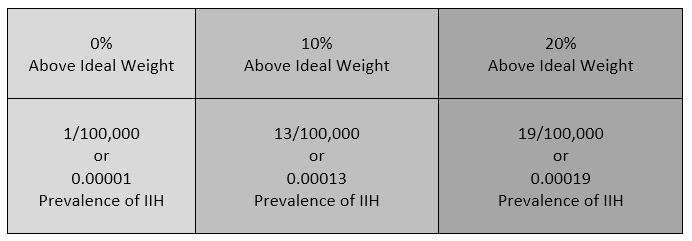
    IIH is a neurological disorder where the cerebrospinal fluid within the skull is elevated, without the presence of a space-occupying mass, edema (brought on by things such as trauma, infection, or disease), or any adverse reactions to certain medications. Studies show that IIH is more common amongst women between the ages of 20 and 50,[8] and there is a slight increase amongst those that are overweight. Some studies also suggest a connection between obstructive sleep apnea and transverse cerebral venous sinus stenosis.[9] Amongst the general population, IIH is believed to exist in 1/100,000 (0.00001). Amongst those that are 10% above their ideal body weight, the numbers increase to 13/100,000 (0.00013), and rising to 19/100,000 (0.00019) in those 20% above their ideal body weight.[10] Although doctors often tend to pass this off as merely a side effect of weight gain, the increase is slim and seems to decrease as the percentage of weight gain above ideal weight continues to rise above the 10% margin. Additionally, the weight factor excludes men and children under the age of 10, which may simply be because women are more likely than men to have comorbid conditions that would lead to Intracranial Hypertension. Studies show that the women to men ratio for Chiari Malformation is believed to be 3:1 and those with both Chiari Malformation and Ehlers-Danlos Syndromes 9:1[11]). However weight is not irrelevant with IIH, the overweight/obese patient population report finding improvement of some symptoms when weight loss of 5-10% of one’s overall body weight, when accompanied by a low-salt diet[12]. 
     

    UNDERSTANDING THE IH/IIH CONNECTION: THE MONRO-KELLIE DOCTRINE
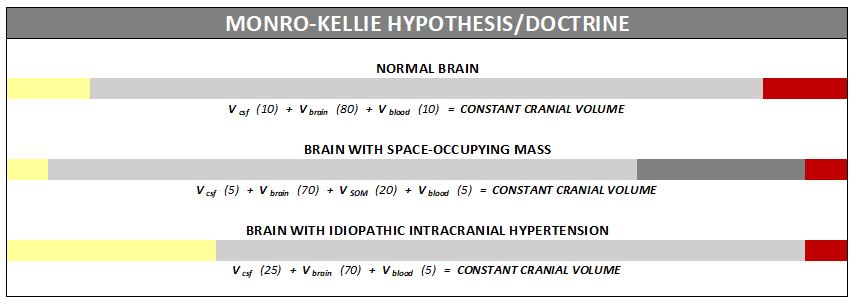
    The association between IH/IIH and Chiari Malformation, appears to be a malicious intricate pathological circle. The cranium (skull) consists of brain matter, cerebrospinal fluid, and both venous and arterial blood. A hypothesis, referred to as the Monro-Kellie Hypothesis (or Monro-Kellie Doctrine), states, “The sum of volumes of brain, CSF, and intracranial blood is constant. An increase in one should cause a decrease in one or both of the remaining two.”[13] Therefore, if there is an abundance of cerebrospinal fluid (IIH or hydrocephalus), both cranial blood volume and brain matter should be forced to deplete. This depletion is usually directed in the path of least resistance – through the foramen magnum and into the spinal canal. When the cranial brain matter closest to the bottom of the skull (cerebellar tonsils) goes through the foramen magnum and into the spinal canal (an Acquired Chiari Malformation), it blocks the flow of cerebrospinal fluid, which in turn, continues to raise intracranial pressure.
     

    SYMPTOMS OF INTRACRANIAL HYPERTENSION
    Intracranial Hypertension (IH) can be either acute or chronic and comes with a variety of symptoms, many of which can help distinguish IH pain from typical pain associated with Chiari Malformation. A typical Chiari headache originates at the back of the skull (at the occiput), but IH headaches are usually described as pressure at the top of the head, that radiates downward. Headaches tend to be worse when laying down (which is opposite of low pressure headaches that are often relieved by laying down). Those that suffer from IH, often report waking up from sleep with a bad headache, and often a slight incline can help alleviate the headache pain. Pulsatile Tinnitus occurs when you hear a ringing in your ears that coincides with your heart beat. The tale-tell symptom of IH involves the damage done to the optical nerves.  Papilledema is when the optic discs swell in response to the increased cranial pressure.[14] Symptoms of Papilledema include: headaches behind the eyes, blurred vision, fleeting vision, dimmed vision, double vision, visual obscurations, decreased peripheral vision, and photopsia. Another source of IH damage is seen in the pituitary gland and is known as Empty Sella Syndrome (ESS). As the high intracranial pressure (ICP) tries to take over, cerebrospinal fluid finds its way to the sella turcica and starts filling it with spinal fluid (partially or completely)[15]. The intruding CSF attempts to envelope this depression in the sphenoid bone, and squeezes the pituitary gland, flattening it until it appears “empty.” While some initially suffer no symptoms of the damage done to the pituitary gland, most eventually develop a variety of hormonal issues, known as hypopituitarism.


    DIAGNOSIS CRITERIA

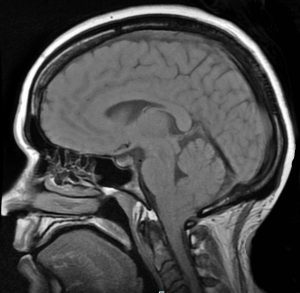
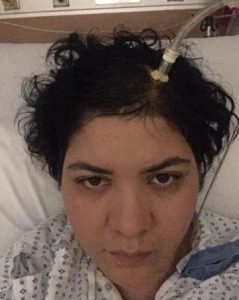
    Diagnosis of Intracranial Hypertension usually begins with investigating either the headaches or the vision problems. The least invasive test is having a neuro-ophthalmologist check behind your eyes for Papilledema. It is not considered conclusive in testing for IH, but it is essential in determining the extent of the damage to the optical nerves. Magnetic Resonance Imaging (MRI) of the brain can be useful in showing signs of Intracranial Hypertension. In cases where one or more space-occupying masses exists, further imaging and often biopsy may be required. The type of mass, its exact location, and the amount of damage that it is believed to be doing, will be used to determine the best treatment. If imaging gives an indication that the intracranial pressure is high, but no space-occupying mass exists, additional testing is usually necessary to confirm, some of which can be potentially be dangerous for those with Heritable Disorders of Connective Tissue (HDCT), such as Ehlers-Danlos Syndromes (EDS). Lumbar punctures (LP), also known as a spinal tap, are often used to test the opening CSF pressure, but by puncturing the dura (which is thinner than normal with Connective Tissue Disorders), the risk of a CSF leak is high. When an LP causes a CSF leak, the first indication is usually a post-dural-puncture headache (PLPH) and eventually, the intracranial hypertension will decrease, as the leak causes intracranial hypotension.[16] CSF leaks can escalate very quickly and can be difficult to identify and treat; therefore, we recommend that LPs be done only when absolutely necessary, and that they be done only under fluoroscopy, by qualified surgeons that fully understand the likelihood of Connective Tissue Disorders, the symptoms of leaks, and have a plan of action should those symptoms occur. Sometimes, ICP can fluctuate and have high spikes that cause problems, rendering LPs useless unless they are done at the precise time. When these spikes are suspected ICP monitoring bolts might be the better option, but still poses a risk of leaks.[17] 
     

    TRANSVERSE SINUS STENOSIS (TSS)

    Transverse sinus stenosis (TSS) occurs when there is a narrowing of the transverse sinus (dural venous sinus), which in turn can compromise cerebral venous outflow. TSS is common in idiopathic intracranial hypertension (IIH). Depending on the study that you are reading, it is proving to be present in 65-100% of those diagnosed specifically with IIH. Its direct connection seems relatively obscure, and there is no indication of its prevalence in intracranial hypertension (IH), but it is worth looking for and treating if found. While scholars remain undecided as to whether TSS is a cause or consequence of IH, if it does prove to be a cause of high pressure, IIH will likely no longer have an idiopathic element to it and it will become another etiology of Intracranial Hypertension. TSS can often be undetectable with standard Magnetic Resonance Imaging (MRI). The correct procedure would be Magnetic Resonance Venography (MRV, with the ATECO technique [18]), specifically looking for signs of stenosis, to include looking for fistula(s) and aneurysm(s). The lack of a fistula or aneurysms however, does not exclude the possibility of a TSS existing (remember it’s being found in 65-100% of those with IIH). Even with MRV, TSS can often be misinterpreted as “flow-related artifacts.” [18] Because the prevalence of TSS in IIH patients is high (some studies call it “universal”) [19], we recommend that all IIH patients have a MRV with the ATECO technique done before surgical treatment and that venous stenting be considered as a viable surgical treatment.


    TREATMENT OPTIONS
    Treatments for Idiopathic Intracranial Hypertension usually starts with weight loss and/or medicinal options; Diamox (Acetazolamide) and Topamax (Topiramate) are most frequently prescribed. Those with IH/IIH should avoid consuming caffeine, as it can increase pressure and therefore is counter-productive to treatment measures. Diamox is a carbonic anhydrase inhibitor and Topamax can also inhibit carbonic anhydrase, but is an anticonvulsant, often prescribed for the treatment of neuropathy and seizure disorders. Both are believed to successfully lower the production of cerebrospinal fluid. Topamax can also help suppress the appetite, which can help with weight loss, but it also comes with many side-effects like all nerve meds do. When medication fails to decrease ICP, a Ventriculoperitoneal Shunt (VP Shunt) or Ventriculoatrial Shunt (VA Shunt) are surgically placed to drain cerebrospinal fluid straight from the ventricle. Shunts are known for failing and often need a multitude of revisions. Venous stenting is not a new procedure, yet it is not readily offered. While there are studies indicating that the successful reduction of intracranial pressure can help with TSS. Stenting is not only a surgical treatment for the stenosis (which could significantly reduce the possibility of a life-threatening aneurysm in patients with a connective tissue disorder), but it is also a surgical treatment for intracranial hypertension as it “improves CSF resorption in the venous system.” [18] Therefore, it seems illogical to shunt (just dealing with the pressure) and leave such a potentially life-threatening condition untreated. [20] Studies are indicating as high as a 94% of patients being cured of all IIH symptoms as a direct result of venous stenting. [18] While all surgeries pose a risk of complications, and the statistics for stenting are likely inflated and skewed (like that of decompression surgeries), these statistics on stenting are definitely encouraging!

    Intracranial Hypertension is a complex issue that should be explored whenever a Chiari Malformation exists, before a decompression surgery is performed. When both Intracranial Hypertension and Chiari Malformation are found to co-exist, the treatment should be in consideration of the correlation of the two, as they both are pathological co-factors of one another. Failure to recognize and treat Intracranial Hypertension before or soon after decompression surgery, will increase the likelihood of a failed decompression. While a decompression surgery can lower Intracranial Hypertension, as cerebrospinal fluid is once again allowed to flow, if space-occupying masses or a case of Idiopathic Intracranial Hypertension (where too much cerebrospinal fluid is being created) are left untreated, those problems will still exist after decompression surgery and the high pressure is likely to cause the cerebellar tonsils to fall once again.

    *Revised October 2018


    [wpedon id=”4396″ align=”center”]


    References:

    Jalan, R. “Intracranial Hypertension in Acute Liver Failure: Pathophysiological Basis of Rational Management.” Seminars in Liver Disease., U.S. National Library of Medicine, Aug. 2003, <www.ncbi.nlm.nih.gov/pubmed/14523680>.

    Chang, D, et al. “Benign Intracranial Hypertension and Chronic Renal Failure.” Cleveland Clinic Journal of Medicine., U.S. National Library of Medicine, <www.ncbi.nlm.nih.gov/pubmed/1525975>.

    Holst, Anders Vedel, et al. “A Severe Case of Tetracycline-Induced Intracranial Hypertension.”Dermatology Reports, PAGEPress Publications, 31 Jan. 2011, <www.ncbi.nlm.nih.gov/pmc/articles/PMC4211491/>.

    Sevgi, E, et al. “Drug Induced Intracranial Hypertension Associated with Sulphasalazine Treatment.” Headache., U.S. National Library of Medicine, Feb. 2008, <www.ncbi.nlm.nih.gov/pubmed/18070060>.

    Kelly, S J, et al. “Pseudotumor Cerebri Associated with Lithium Use in an 11-Year-Old Boy.”Journal of AAPOS : the Official Publication of the American Association for Pediatric Ophthalmology and Strabismus., U.S. National Library of Medicine, Apr. 2009, <www.ncbi.nlm.nih.gov/pubmed/19393521>.

    Aylward, Shawn C. “Intracranial Hypertension: Is It Primary, Secondary, or Idiopathic?”Journal of Neurosciences in Rural Practice, Medknow Publications & Media Pvt Ltd, 2014, <www.ncbi.nlm.nih.gov/pmc/articles/PMC4173226/>.

    Etminan, Mahyar, et al. “Risk of Intracranial Hypertension with Intrauterine Levonorgestrel.”Therapeutic Advances in Drug Safety, SAGE Publications, June 2015, <www.ncbi.nlm.nih.gov/pmc/articles/PMC4519742/>.

    “Pseudotumor Cerebri Information Page.” National Institute of Neurological Disorders and Stroke, U.S. Department of Health and Human Services, <www.ninds.nih.gov/Disorders/All-Disorders/Pseudotumor-Cerebri-Information-Page>.

    Thurtell, Matthew J., et al. “An Update on Idiopathic Intracranial Hypertension.” Reviews in Neurological Diseases, U.S. National Library of Medicine, 2010, <www.ncbi.nlm.nih.gov/pmc/articles/PMC3674489/>.

    10 Wani, Irfan Yousuf, et al. “Complete Ophthalmoplegia: A Rare Presentation of Idiopathic Intracranial Hypertension.” Annals of Indian Academy of Neurology, Medknow Publications & Media Pvt Ltd, 2015, <www.ncbi.nlm.nih.gov/pmc/articles/PMC4683894/>.

    11 Henderson, Fraser C., et al. “Neurological and Spinal Manifestations of the Ehlers–Danlos Syndromes.” American Journal of Medical Genetics Part C: Seminars in Medical Genetics, 21 Feb. 2017, <www.onlinelibrary.wiley.com/doi/10.1002/ajmg.c.31549/full>.

    12 Thurtell, Matthew J., and Michael Wall. “Idiopathic Intracranial Hypertension (Pseudotumor Cerebri): Recognition, Treatment, and Ongoing Management.” Current Treatment Options in Neurology, U.S. National Library of Medicine, Feb. 2013,<www.ncbi.nlm.nih.gov/pmc/articles/PMC3554852/>.

    13 Mokri, B. “The Monro-Kellie Hypothesis: Applications in CSF Volume Depletion.” Neurology., U.S. National Library of Medicine, 26 June 2001, <www.ncbi.nlm.nih.gov/pubmed/11425944>.

    14 Schirmer, Clemens M, and Thomas R Hedges. “Mechanisms of Visual Loss in Papilledema.”Journal of Neurosurgery, <www.thejns.org/doi/full/10.3171/FOC-07/11/E5>.

    15 “Empty Sella Syndrome Information Page.” National Institute of Neurological Disorders and Stroke, U.S. Department of Health and Human Services, <www.ninds.nih.gov/Disorders/All-Disorders/Empty-Sella-Syndrome-Information-Page>.

    16 Panikkath, Ragesh, et al. “Intracranial Hypertension and Intracranial Hypotension Causing Headache in the Same Patient.” Proceedings (Baylor University. Medical Center), Baylor Health Care System, July 2014, <www.ncbi.nlm.nih.gov/pmc/articles/PMC4059569/>.

    17 Abraham, Mary, and Vasudha Singhal. “Intracranial Pressure Monitoring.” Journal of Neuroanaesthesiology,  <www.jnaccjournal.org/article.asp?issn=2348-0548;year=2015;volume=2;issue=3;spage=193;epage=203;aulast=Abraham>.

    18 Ahmed, Wilkinson, et al. “Transverse Sinus Stenting for Idiopathic Intracranial Hypertension: A Review of 52 Patients and of Model Prediction.” American Society of Neuroradiology, July 2011. <www.ajnr.org/content/32/8/1408.long>.

    19 Riggeal, Bruce, et al. “Clinical course of idiopathic intracranial hypertension with transverse sinus stenosis.” American Academy of Neurology, 2012. <www.ncbi.nlm.nih.gov/pmc/articles/PMC3589184/>.

    20 Patel, et al. “Evaluating and treating venous outflow stenoses is necessary for the successful open surgical treatment of arteriovenous fistula aneurysms.” Society for Clinical Vascular Surgery, Volume 61, Issue 2. February 2015. <www.sciencedirect.com/science/article/pii/S0741521414014116>.




  • The Chiari Malformation Ehlers-Danlos Connection

    The Chiari Malformation Ehlers-Danlos Connection

    CHIARI (KEE-AR-EE) MALFORMATIONS ARE FAR FROM RARE, THEY ARE JUST RARELY UNDERSTOOD, EVEN BY MOST MEDICAL PROFESSIONALS. A CHIARI MALFORMATION EXISTS WHEN THE LOWEST PART OF THE HIND BRAIN (THE CEREBELLAR TONSILS) PROLAPSES INTO THE HOLE AT THE BOTTOM OF THE SKULL (FORAMEN MAGNUM), ENTERS THE SPINAL CANAL AND OBSTRUCTS THE FLOW OF CEREBROSPINAL FLUID (CSF), PUTS PRESSURE ON THE BRAIN STEM AND SPINE, AND MAY RESULT IN VARYING DEGREES OF NERVE COMPRESSION.

    PREVALENCE OF CHIARI: Once thought to occur in 1 in 1000 people, it is now believed to be much more frequent of an occurrence. A 2016 pediatric study found it to occur in 1 in 100 children[1]. Since Chiari Malformation Type 1, the most common type, tends to become symptomatic during late teens and early adulthood, it is likely to be much more common when adults are factored in.

    THE CONNECTION: Chiari malformations were originally believed to be caused by a posterior fossa hypoplasia (small area inside the back of the skull) and doctors speculated that lack of maternal prenatal care or drug abuse caused the deformity. However, as studies continue, they are finding that many with this hind brain herniation have connective tissue disorders, such as Ehlers-Danlos Syndromes. Ehlers-Danlos Syndromes involve a mutation in one of the collagen genes. Collagen is a protein that is often described as a “cellular glue” that helps hold the body together. When that glue fails to hold, everything seems to go awry; specifically, as related to Acquired Chiari Malformations: organs tend to prolapse, and bones begin to shift as joint laxity increases (including the bones/vertebrae at the craniocervical junction). They are finding that these acquired Chiari malformations are far more common than originally thought. There are many pathological co-factors that can cause or attribute to the formation of a Chiari Malformation, and most can be linked to these Heritable Disorders of Connective Tissues (HDCTs), including a posterior fossa hypoplasia. In one large study, they found those with a Chiari malformation and no associated co-factors, with only slightly over 52% having a small Posterior Cranial Fossa (PCF). When other co-factors were present, the number of Chiarians found with a small PCF plummeted and therefore it is should be considered acquired until proven otherwise.[2]

    DIAGNOSES: A decade ago, it took 10-20 years from the onset of symptoms to be diagnosed and now it takes an average of 1-2 years, because medical professionals are slowly beginning to look for it. Magnetic Resonance Imaging (MRI) remains the best tool for diagnosis. Some medical professionals believe that a tonsillar herniation of less than 5mm is simply a tonsillar ectopia and only diagnose a Chiari malformation when the descent is > 5mm. However, the 5mm requirement is controversial and many doctors now base their diagnoses not solely on measurements, but rather on symptomology and a combination of other factors (including Cine MRI, a patient’s symptoms, and other relevant factors). Due to the prevalence of connective tissue issues, gravity often proves to be a significant factor and should be taken into account by use of an upright MRI whenever possible.[3] EDS should be diagnosed by a geneticist before surgery is considered.

    TREATMENT OPTIONS: There is no cure for a Chiari malformation, but there are treatment options. When symptoms are minimal and not life-altering, pain management is usually offered. However, it is important to know that while medications may ease some symptoms, Chiari symptoms tend to be progressive. Decompression surgery is the only treatment available to attempt to halt the progression of the damage being done to your Central Nervous System (CNS). The most common reason that decompression surgeries fail, is undiagnosed co-morbid conditions, especially those that can be etiological/pathological co-factors. More than one surgery might be necessary to successfully treat a Chiari malformation and any/all co-morbid conditions and there is a correlation between early surgical intervention and positive surgical outcomes[4].

    [wpedon id=”4396″ align=”center”]


    References:

    1 Eltorai, Ibrahim M. “Rare Diseases and Syndromes of the Spinal Cord” Cham: Springer International Publishing: Imprint: Springer, 2016. Page 43, 15.2, <www.springer.com/us/book/9783319451466>.

    2 Milhorat, Thomas H., et al. “Mechanisms of Cerebellar Tonsil Herniation in Patients with Chiari Malformations as Guide to Clinical Management.” Acta Neurochirurgica, Springer Vienna, July 2010, <www.ncbi.nlm.nih.gov/pmc/articles/PMC2887504>.

    3 Henderson, Fraser C., et al. “Neurological and Spinal Manifestations of the Ehlers–Danlos Syndromes.” American Journal of Medical Genetics Part C: Seminars in Medical Genetics, 21 Feb. 2017, <www.onlinelibrary.wiley.com/doi/10.1002/ajmg.c.31549/full>.

    4 Siasios, John, et al. “Surgical Management of Patients with Chiari I Malformation” International Journal of Pediatrics, Article ID 640127, Hindawi, 2012, <https://www.hindawi.com/journals/ijpedi/2012/640127>.

  • Overview: Chiari Treatment Options & Potential Pitfalls

    Overview: Chiari Treatment Options & Potential Pitfalls

    Once diagnosed, you will usually be referred to a specialist (not a Chiari Specialist, but an everyday, run-of-the-mill neurologist or neurosurgeon). They tend to come in one of two types: Either they are very passive and just want to wait and see how bad it gets, or they are very pro-surgery and while they will still usually give you a 50% chance of helping your symptoms, they will tell you how decompression surgery really is your best option. Both are problematic.
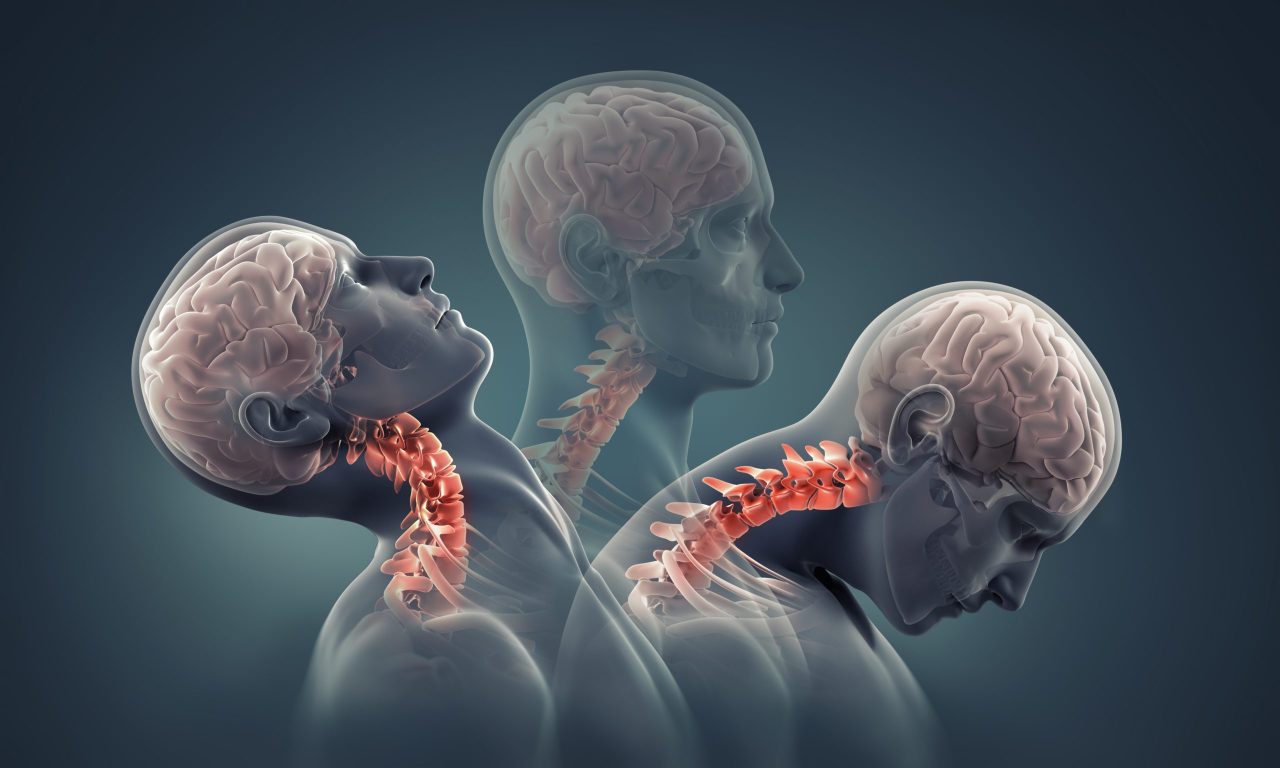
    FOR THE ASYMPTOMATIC CHIARIAN:
    Without a doubt, the passive approach is by far the best plan of action for the asymptomatic Chiari patient. Approximately 30% of those with a Chiari 1 malformation can go their entire lives without having symptoms (in fact, many remain undiagnosed and don’t even know they have it because they have no symptoms).[1] The Chiari is often discovered while looking for something else entirely and is therefore considered an “Incidental Finding.” While there is a chance that the Chiarian will become symptomatic one day, the risks of surgical complications exceed the potential benefit on something that has not and might not ever affect their life.

    FOR THE SYMPTOMATIC CHIARIAN:
    If the Chiarian is symptomatic, however, “Decompression Surgery is the only treatment available [at this time] to correct functional disturbances or halt the progression of damage to the central nervous system. Most individuals who have surgery see a reduction in their symptoms and/or prolonged periods of relative stability. More than one surgery may be needed to treat the condition.”[2] Despite the reasons for haste however, we do recommend slowing down and making sure that adequate testing is done to ensure that the Chiari is a “Congenital Chiari” formed only by a small posterior fossa, with no other etiological/pathological co-factors that could make it an “Acquired Chiari Malformation.” If not identified and addressed, these etiological/pathological co-factors can cause complications and even lead to a failed decompression surgery. (Note: most are told at diagnosis that it is a “congenital defect.” However, that is usually a presumption on their part, stemming from a lack of knowledge of Chiari and its comorbidities, and them giving too much credence to the paragraph or two on Chiari malformations in their medical school textbooks. That is not the reality that many are dealing with; so, testing is imperative!)

    TESTING:
    If you have been diagnosed with a Chiari malformation or a tonsillar ectopia (regardless of the size of tonsillar descent), you should have the following tests/images done.

    1. A sleep study to check for Sleep Apnea.

    • Central Sleep Apnea (CSA) is more common with Chiari, especially when there has been damage to the brainstem or Vagus Nerve.

    • Obstructive Sleep Apnea (OSA) is commonly linked with obesity in the general population, it is also very common amongst those with Connective Tissue Disorders (such as Ehler’s-Danlos Syndrome).

    • Both CSA and OSA can be present in the Chiarian with a Connective Tissue Disorder. When both are causing apnea, it becomes known as “Complex Sleep Apnea.”

    • Sleep Apnea, regardless of the type, is a common “killer” amongst Chiarians.


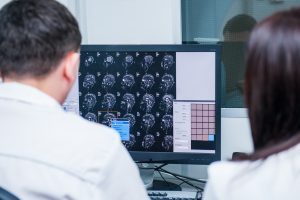
    2. A brain and full spine MRI (upright recommended) with and without contrast.

    What they should be looking for in these MRIs:

    a) Do you have a syrinx (Syringomyelia or Syringobulbia)?

    • If you have either, that is proof that the blockage of CSF is significant enough to cause these potentially serious complications.

    b) Is any part of your brainstem below the foramen magnum?

    • If it is, you have a variant of Type 1, known as a Chiari 1.5[3] or Type 2, both indicate that there is something else going on causing the brainstem to herniate along with the cerebellar tonsils. 

    c) Do you have a cyst/tumor causing increased intracranial pressure that is pushing the cerebellar tonsils down?

    • If you have either, and they are operable, there is a chance that surgically removing it could decrease the intracranial pressure and allow the cerebellar tonsils (and brainstem if it is below the foramen magnum at all) to go to proper position. Furthermore, if the cyst/tumor is not addressed before, during, or soon after decompression surgery, the chances of your tonsils herniating again after decompression are high.[4]

    d) Do you have Hydrocephalus causing increased intracranial pressure that is pushing the cerebellar tonsils down?

    • If you do, there is a chance that the placement of a Ventriculoperitoneal Shunt could decrease the intracranial pressure enough to allow the cerebellar tonsils (and brainstem if it is below the foramen magnum at all) to go to their proper position. Furthermore, if the Hydrocephalus is not addressed before, during, or soon after decompression surgery, the chances of your tonsils herniating again after decompression are high.[5]

    e) Do you have signs/symptoms of Idiopathic Intracranial Hypertension (often shows as excessive fluid above the lateral ventricles, with small, “slit-like” lateral ventricles; usually accompanied by Papilledema and/or Empty Sella Syndrome), which can cause enough cranial pressure that it can push your cerebellar tonsils down?

    • If you do, there is a chance that a prescription for Diamox or Topamax, or the surgical placement of a Ventriculoperitoneal Shunt, could reduce the pressure enough to allow the cerebellar tonsils (and brainstem if it is below the foramen magnum at all) to go into proper position. Studies exist both in favor of shunting first and doing the decompression first; there are documented cases where unresolved IH has led to failed decompression surgeries, while other cases attribute a Chiari decompression as being that which resolved IH symptoms.[6/7]

    f) Do you have signs/symptoms of Tethered Cord Syndrome that could be pulling on the spine from below?

    • If you do, there is a chance that a less invasive surgery known as a Tethered Cord Release, could stop the downward pulling of the spinal cord and allow the cerebellar tonsils (and brainstem if it is below the foramen magnum at all) to go into proper position. Furthermore, if the Tethered Cord is not addressed before, during, or soon after decompression surgery, the chances of your tonsils herniating again after decompression are high. (Note: not all Tethered Cords are easily visible by MRI, when they are not visible, it is called Occult Tethered Cord (OTC) and surgery on a OTC remains controversial.)[8]

    g) Do you have signs/symptoms of Intracranial Hypotension (CSF Leak) that could be pulling or creating a suctioning effect from below?

    • If you do, there is a chance that a less invasive blood patch or a Dural Tear Repair Surgery, could stop the downward pulling/suctioning effect on the spinal cord and allow the cerebellar tonsils (and brainstem if it is below the foramen magnum at all) to go into proper position. Furthermore, if the leak(s) are not addressed before, during, or soon after decompression surgery, the chances of your tonsils herniating again after decompression are high. (Note: not all leaks are easily visible by MRI.)[9]

    h) Do you have signs of Spina Bifida (Myelomeningocele, Meningocele, or Spina Bifida Occulta)?

    • While it is important to know if any of these exist, a Myelomeningocele would put you at an increased risk of having a Chiari Type 2. While all Chiari Malformations with a Myelomeningocele do not meet the standards for Type 2, 90% of those with a Myelomeningocele have a Chiari Type 2. Most neurosurgeons will not perform a decompression on someone with a Myelomeningocele because of the risk of further complications.[10]

    i) Do you have signs/symptoms of disc degeneration problems and/or stenosis, especially in the cervical spine where it can damage the Vagus Nerve?

    • If you do, these could be another sign of a connective tissues disorder. If you have a syrinx above a herniated/bulging disc, there is a good chance that the disc is attributing to it. Herniated/bulging discs in the cervical spine can be quite troublesome. They can usually be addressed by a second procedure called an Anterior Cervical Discectomy and Fusion (ACDF), but if there are multiple cervical problems and Craniocervical Instability, some surgeons will opt to do a fusion at the time of decompression.[11]

    j) Do you have signs and symptoms of a cervicomedullary syndrome[12], which are often the result of Craniocervical Instability (CCI), Atlantoaxial Instability (AAI), or both. (CCI and AAI can be confirmed with: An upright c-spine MRI with flexion, extension, and neutral views or a 3D cervical CT with rotational views.)

    • CCI/AAI can produce many of the same symptoms as Chiari 1 malformation, including occipital or craniocervical junction headaches made worse by Valsalva maneuvers. It has been theorized that CCI/AAI may also be capable of causing or worsening a herniation of the cerebellar tonsils, and it has been demonstrated that CCI can cause ventral brainstem compression and deformative stress injury to the brainstem.[13] Failure to diagnose and treat CCI before or along with decompression has also been linked to decompression failure. CCI and AAI, while rare in the general population, are relatively common in patients with HDCT’s (Heritable Disorders of Connective Tissue), such as Ehlers-Danlos Syndrome. CCI, when identified to be the root cause of significant symptoms, can be treated conservatively, and in the short term, with the use of a hard-cervical collar, physical therapy and, possibly, traction. More permanent treatment in the form of a fusion and stabilization surgery (fusing the occiput to C1, C2, and sometimes additional vertebrae).[12/13]

    3. A preliminary check for connective tissue disorder (especially Ehler’s-Danlos Syndrome). If preliminary results indicate the presence of a connective tissue disorder, genetic testing should be done to rule out more serious types.


    IF NONE OF THESE PROBLEMS APPEAR TO EXIST: 

    Some doctors and patients prefer to wait and just treat the symptoms medically. That is your choice to make and you should never let anyone try to bully you or manipulate you into having surgery or not; although it is important to know that statistics show that those who have had a shorter duration of onset of symptoms and surgery tend to have a better surgical outcome.[14]

    Statistics show that 80% of decompressed patients report some relief from some of their symptoms; headaches are the most commonly reported symptom to gain relief (81%).

    Most surgeons will give a 50% chance of relieving each symptom individually, with the exception of pain associated with damaged nerves.

    While some surgeons prefer a conservative approach to surgery such as a “bone only” decompression or a “Minimally Invasive Subpial Tonsillectomy,”[15] a full decompression usually consists of:

    Craniectomy: removal of part of the sub-occipital skull.

    Laminectomy of C1 (and sometimes C2): removal of the lamina from the vertebra.

    Duraplasty: opening of the dura (the outermost membrane enveloping the brain and spinal cord) and patching it so there is more room.

    Cerebellar Tonsillectomy: removal/cauterization of the cerebellar tonsils.


    IS DECOMPRESSION SURGERY A CURE FOR A CHIARI MALFORMATION? 

    There is a fundamental problem with the question and what many neurologists and neurosurgeons believe about decompression surgery. For the patient, the symptoms are synonymous with the condition. If we continue to struggle living our lives because of these symptoms, having a doctor that refuses to validate that struggle, can add insult to injury. Decompression surgery should NEVER be considered a cure to the symptoms of a Chiari malformation, it is merely the only treatment available [at this time] to correct functional disturbances or halt the progression of damage to the central nervous system. The likelihood of continued symptoms is almost absolute, Decompression is only a means of reestablishing the flow of CSF between the brain and spinal canal (which is imperative). Once flow is restored, there should be some relief from many of the symptoms. Complications such as Syringomyelia should be reduced or resolved, so the possibility of paralysis is significantly reduced. With as bad as the pain and symptoms are, it really can get worse if left untreated. Finding a specialist that is not only experienced with decompression surgeries, but who fully understands the correlation and treatment of etiological/pathological co-factors and co-morbid conditions, substantially increases the likelihood of a positive surgical outcome.


    [wpedon id=”4396″ align=”center”]


    References:

    1 Elster, A D, and M Y Chen. “Chiari I Malformations: Clinical and Radiologic Reappraisal.”Radiology., U.S. National Library of Medicine, May 1992, <www.ncbi.nlm.nih.gov/pubmed/1561334>.

    2 “Chiari Malformation Fact Sheet.” National Institute of Neurological Disorders and Stroke, U.S. Department of Health and Human Services, June 2017, <www.ninds.nih.gov/Disorders/Patient-Caregiver-Education/Fact-Sheets/Chiari-Malformation-Fact-Sheet>.

    3 Kim, In-Kyeong, et al. “Chiari 1.5 Malformation : An Advanced Form of Chiari I Malformation.”Journal of Korean Neurosurgical Society, The Korean Neurosurgical Society, Oct. 2010, <www.ncbi.nlm.nih.gov/pmc/articles/PMC2982921/>.

    4 Wang, J, et al. “Acquired Chiari Malformation and Syringomyelia Secondary to Space-Occupying Lesions: A Systematic Review.” World Neurosurgery., U.S. National Library of Medicine, Feb. 2017, <www.ncbi.nlm.nih.gov/pubmed/27894943>.

    5 Graham, A, et al. “An Unusual Cause of Neck Pain: Acquired Chiari Malformation Leading to Brainstem Herniation and Death.” The Journal of Emergency Medicine., U.S. National Library of Medicine, Dec. 2012, <www.ncbi.nlm.nih.gov/pubmed/21215551>.

    6 Fagan, L H, et al. “The Chiari Pseudotumor Cerebri Syndrome: Symptom Recurrence after Decompressive Surgery for Chiari Malformation Type I.” Pediatric Neurosurgery., U.S. National Library of Medicine, 2006, <www.ncbi.nlm.nih.gov/pubmed/16357496>.

    7 Park, Michael S., et al. “Coexistent Chiari Malformation and Idiopathic Intracranial Hypertension: Which Should Be Treated First?- Case Report and Review.” JSM Neurosurg Spine, vol. 2, no. 3, ser. 1025, 20 Mar. 2014. 1025, <www.jscimedcentral.com/Neurosurgery/neurosurgery-2-1025.pdf>.

    8 Milhorat, T H, et al. “Association of Chiari Malformation Type I and Tethered Cord Syndrome: Preliminary Results of Sectioning Filum Terminale.” Surgical Neurology., U.S. National Library of Medicine, July 2009, <www.ncbi.nlm.nih.gov/pubmed/19559924>.

    9 Atkinson, J L, et al. “Acquired Chiari I Malformation Secondary to Spontaneous Spinal Cerebrospinal Fluid Leakage and Chronic Intracranial Hypotension Syndrome in Seven Cases.” Journal of Neurosurgery., U.S. National Library of Medicine, Feb. 1998, <www.ncbi.nlm.nih.gov/pubmed/9452230>.

    10 Vandertop, William P., et al. Surgical Decompression for Symptomatic Chiari II Malformation in Neonates with Myelomeningocele. Oct. 1992, <www.thejns.org/doi/abs/10.3171/jns.1992.77.4.0541>.

    11 Dahdaleh, Nader S., and Arnold H. Menezes. Incomplete Lateral Medullary Syndrome in a Patient with Chiari Malformation Type I Presenting with Combined Trigeminal and Vagal Nerve Dysfunction. 2008, <www.thejns.org/doi/pdf/10.3171/PED.2008.2.10.250>.

    12 Henderson, Fraser C., et al. “Neurological and Spinal Manifestations of the Ehlers–Danlos Syndromes.” American Journal of Medical Genetics Part C: Seminars in Medical Genetics, 21 Feb. 2017, <www.onlinelibrary.wiley.com/doi/10.1002/ajmg.c.31549/full>.

    13 Henderson, FC, et al. “Deformative Stress Associated with an Abnormal Clivo-Axial Angle: A Finite Element Analysis.” Surgical Neurology International, 16 July 2010, <www.europepmc.org/articles/PMC2940090/>.

    14 Ma, J, et al. “Cerebellar Tonsillectomy with Suboccipital Decompression and Duraplasty by Small Incision for Chiari I Malformation (with Syringomyelia): Long Term Follow-up of 76 Surgically Treated Cases.” Turkish Neurosurgery., U.S. National Library of Medicine, 2012, <www.ncbi.nlm.nih.gov/pubmed/22664992>.

    15 Beecher, Jeffrey S., et al. “Minimally Invasive Subpial Tonsillectomy for Chiari I Decompression.” Acta Neurochirurgica, Springer Vienna, 5 July 2016, <www.ncbi.nlm.nih.gov/pmc/articles/PMC4980444/>.

  • Overview: Craniocervical Instability and Related Disorders

    Overview: Craniocervical Instability and Related Disorders

    Craniocervical Instability and related pathologies of the craniocervical junction are an important topic for anyone diagnosed with Chiari 1 malformation. “Complex Chiari,” or the presence of craniovertebral abnormalities or instability in addition to the presence of cerebellar tonsillar herniation, is present in approximately one fourth of all cases of Chiari 1 malformation[1]. These cases usually involve the presence of a genetic connective tissue disorder and are thought by experts to be the cause of most Chiari decompression failures[2]. When the doctor and patient alike are not knowledgeable about these conditions and the additional symptoms that often accompany them, these more complex cases are often treated with a standard decompression, which can actually weaken the stability of the craniocervical junction more, and result in an increase of symptoms rather than a clinical improvement. Understanding what signs and symptoms to look for that may indicate that your Chiari is more complex, is vital in receiving the appropriate treatment the first time. This is especially important considering that, according to Chiari expert Paolo Bolognese, M.D., “[with revision surgeries], the results are not as good as if you had done the posterior decompression well the first time.”[3]

    Punjabi and White define instability as the “loss of the ability of the spine under physiological loads to maintain relationships between vertebrae in such a way that there is no damage or subsequent irritation of the spinal cord, (brain stem) or nerve roots, and in addition that there is development of deformity or incapacitating pain due to structural changes.”[4] This means that the ligaments and muscles that normally hold the spine together, are too weak or damaged to handle the normal range of motion and weight of anatomic structures. For example, in Craniocervical Instability, the neck is not strong enough to support the normal weight of the head, without elements of the spine moving in such a way that it causes pain or damage to the nervous system (spinal cord, brain stem, and even cranial nerves). The result is that the bones that make up the lower skull and upper spine get pushed out of their normal anatomic location and begin to impinge on or cause stretching of these parts of the nervous system.

    Craniocervical Instability can result from or be exacerbated by a trauma, such as a severe whiplash injury. However, many cases of CCI are associated with some sort of connective tissue disorder, such as a heritable disorder of connective tissue (HDCT, like Ehlers-Danlos Syndrome or Marfan’s), or an autoimmune condition that affects the connective tissue (such as Rheumatoid Arthritis), or a few other rarer conditions that affect the integrity of bony structures in the skull and spine. Instability can result either from lax ligaments and other connective tissues, soft bones (also seen in HDCTs) or from something like pannus formation, where repeated rubbing together of the joints causes a build-up of granulated tissue around bony structures and changes the way certain bones lie in relationship to one another[5]. Craniocervical Instability can also result as a complication of Chiari decompression surgery, when too much bone is removed from the skull, resulting in the instability of the skull on the top of the spine[6].

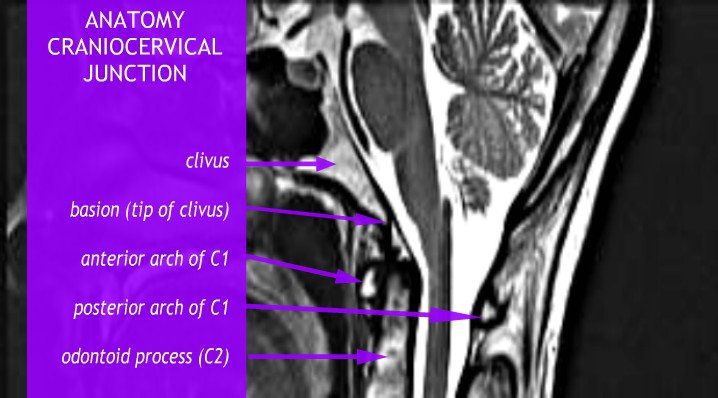
    In the patient community, the term “CCI” is often used in reference to both Craniocervical Instability and Atlantoaxial Instability (AAI). CCI is often used to refer to the commonly seen combination of issues with the craniocervical junction, that include the instability of the joints where the skull meets the C1 vertebrae (which is true CCI), the instability of the joints between C1 and C2 (true AAI), a retroflexed odontoid, pannus formation, and a kyphotic clivo-axial angle (which are all forms of basilar impression/invagination). But CCI really should refer to the movement of the skull with respect to the spine. This sliding is referred to as “translation” and is measured on dynamic imaging in millimeters. The pathological threshold for the degree of translation of the basion with respect to the odontoid process between flexion and extension is 2mm, and any amount of translation greater than 1mm is capable of producing symptoms7. Likewise, at the C1-C2 joint, instability in the form of AAI can cause an excessive uncovering of the joint facets. Facets are the surfaces of the vertebrae that articulate with next vertebra. An uncovering of the facets that exceeds 20% is considered pathological.

    The occipito-atlantic joint allows for about half of the cervical spine’s ability to flex and extend (tilt forward and backward). Likewise, the atlantoaxial joint [the articulation between C1 (atlas) and C2 (axis)] accounts for about half of the cervical spine’s ability to rotate the head. Because of this, these vertebrae lack the same amount of stability as the remainder of the spine, and ligaments are largely responsible for their stability[8]. Therefore, ligamentous laxity, as seen in connective tissue disorders, make these areas of the spine particularly prone to pathologic instability. Symptoms of AAI may include visual changes, syncope (fainting) or near-syncopal episodes, dizziness, nausea, facial pain, difficulty swallowing, choking, respiratory issues, and upper cervical tenderness. These symptoms will usually improve with the use of a neck brace[9]. For patients with connective tissue disorders, as are seen in 12-20% of patients diagnosed with Chiari, dynamic imaging is very important in identifying potential instability. The ideal tests to diagnose CCI and AAI are an upright MRI with flexion and extension and a 3D CT with rotational views, respectively[10]. It is important to note that ventral brain stem compression may not be seen on traditional supine MR imaging, while it may be very evident on dynamic imaging.

    Basilar Invagination and Basilar Impression are also often seen with instability. They are almost identical to one another, and refer to upward displacement of the bones of the spine. However, technically, Basilar Invagination is caused by this deformation with normal bone, while Basilar Impression results from softening of bone[11]. For our purposes, this distinction is less important, but we will discuss any displacement in terms of “Basilar Invagination,” or “BI” for short. Forms of Basilar Invagination now include the prolapse of the odontoid process through the foramen magnum (the original condition described by the term), cranial settling, a kyphotic clivo-axial angle, and a retroflexed odontoid[12]. The kyphotic clivo-axial angle is an important and relatively easy measurement to indicate potential deformative stress on the brain stem. The clivus is a wedge-shaped bone that normally lies above and ventral to the top of spine. When it lies more horizontally, it creates a sharp angle that results in a bending of the brainstem. The odontoid peg (also called the odontoid process or the dens) is the part of the C2 vertebrae, or Axis, that the skull pivots upon, so named because of its tooth-like shape. A retroflexed odontoid occurs when the odontoid is bent backwards, often compressing the front of the brain stem. Other important measurements involving ventral brain stem compression for a kyphotic clivo-axial angle and/or retroflexed odontoid include the Grabb-Oakes and Harris measurements.

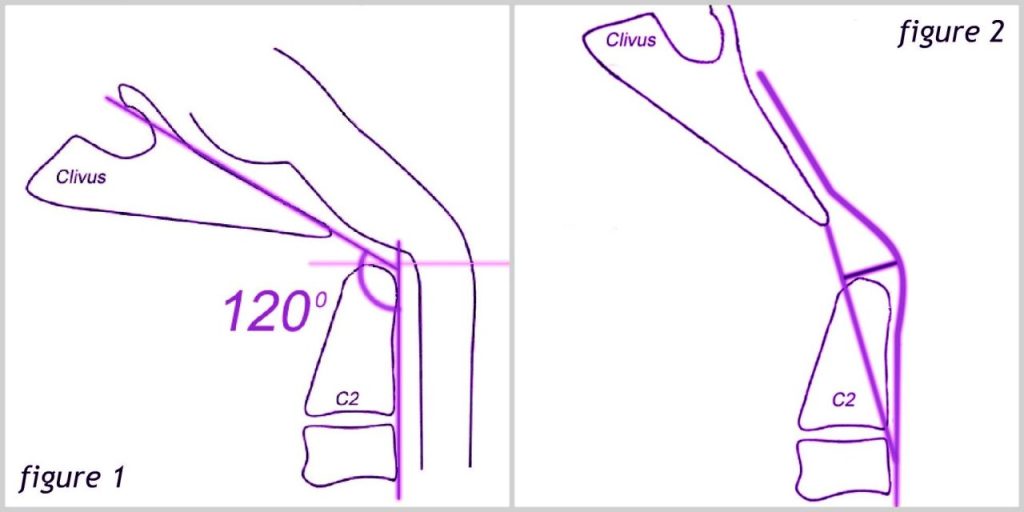
    • The clivoaxial angle is measured by drawing a line along the posterior (back, or when lying more horizontal, the top) side of the lower clivus and intersecting that line with a line drawn on the posterior side of the axis.  If the angle created is less than 135°, it is considered pathological.  Like instability, a kyphotic clivoaxial angle is often seen in patients with connective tissue disorders and degenerative rheumatoid disease[13]See figure 1 below.
    Left – Clivoaxial Angle (CXA). Right – Grabb-Oakes measurement.

    For the Grabb-Oakes measurement, a line is drawn from the basion (the midpoint of the anterior margin of the foramen magnum) to the inferior posterior C2. A perpendicular line is then drawn from the center of this line to the dura of the brain stem. A Grabb-Oakes measurement greater than 9 mm denotes a form of basilar invagination. This is a very helpful measurement for determining how much a retroflexed odontoid is compressing the brain stem. See Figure 2 above.

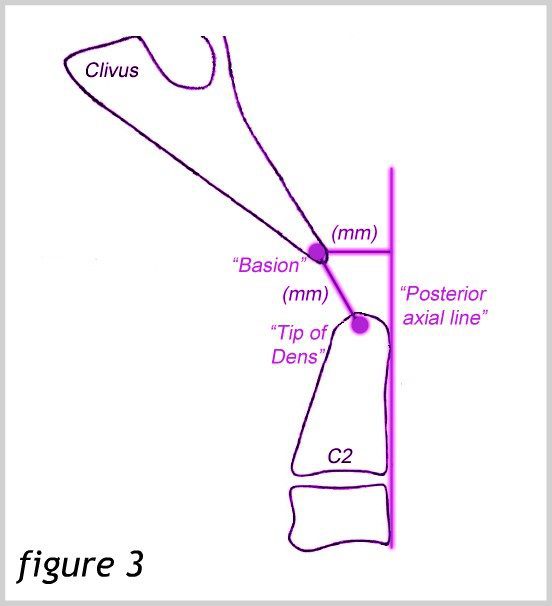
    The Harris measurement is the distance between the basion and the Posterior Axial Line. This distance should not be more than 12 mm. A measurement of more than 12 mm also denotes instability. This measurement can also be used to measure the translation between flexion and extension in dynamic imaging[14]. See Figure 3.

    Harris measurement

    Symptoms of ventral brain stem compression can occur with various types of BI and instability. They may be referred to together as a “cervicomedullary syndrome” and may include[15]:

    • A heavy headache (often referred to as feeling like a “bobblehead” or feeling like the head is a “bowling ball”)
    • A Chiari-type pressure headache aggravated by Valsalva maneuvers (because these conditions, like Chiari, can also cause flow issues)
    • Dysautonomia (including tachycardia, heat intolerance, orthostatic intolerance, syncope (fainting), polydipsia (extreme thirst), delayed gastric emptying, chronic fatigue)
    • Neck pain (often severe)
    • Central or mixed sleep apnea
    • Facial pain or numbness – Occasionally, including Trigeminal Neuralgia
    • Balance and coordination impairment
    • Muscle weakness
    • Dizziness and vertigo
    • Vision problems, including double vision and downward nystagmus
    • Reduced gag reflex and dysphagia (difficulty swallowing)
    • Tinnitus (ringing in the ears) and hearing loss
    • Nausea and vomiting
    • Paralysis
    • In more severe cases, non-epiform seizures have also been documented

    In addition to producing significant pain and neurological symptoms, the compression and kinking of the brain stem can cause significant injury to the brain stem neurons by stretching the axons of the nerves to the point that they break and recoil, producing what are called “axon retraction bulbs” that can be seen on microscopic examination of the cells. The stress placed on the brain stem by both compressing and stretching simultaneously is much greater than the mere sum of these two mechanisms. Interestingly, during the flexion of the normal spine, it stretches 17% of its length. Research has shown that the axon of a giant squid fails when stretched to 20% if its length. Therefore, the normal motion of the human neck brings us very close to injuring our brain stem. Consequently, it only takes a slight alteration of our normal anatomy to cause injury to these delicate nervous tissues[16].

    Treatment of Craniocervical Instability typically begins with more conservative medical management, such as neck bracing, activity limitation, physical therapy (including isometrics, sagittal balance, core strengthening and cardio), and pain management. Other causes of symptoms such as co-morbid conditions, multiple sclerosis, dystrophy, mitochondrial disorders, vitamin deficiencies and Lyme disease should be ruled out or treated. However, surgical intervention via a craniocervical fusion is indicated when the following criteria are met:

    Severe headache or neck pain >7/10
    AND cervicomedullary syndrome
    AND neurological deficits referable to the craniocervical junction
    AND radiological findings indicative of instability

    Surgeons and patients alike should consider surgery after medical management has been maximized and the patient has shown a positive response to neck bracing[10].

    Various specific surgical techniques are applied in craniocervical fusions. A more common technique is the open reduction and fusion stabilization procedure. This procedure involves stabilizing the head with screws, making an incision that exposes the occiput through C2, and fixing plates to the occiput which attach to the C1 and C2 (and sometimes C3) vertebrae with rods. A newer technique adapted by Dr. Paolo Bolognese is using a less invasive Chiari decompression surgery known as MIST (minimally invasive subpial tonsillectomy) along with a fusion using screws placed in the occipital condyles. Although the dura is opened to partially resect the tonsils, a duraplasty is not done. Advantages of this procedure include a smaller incision, smaller hardware, less bone removal, and a thicker bone for which to insert screws in the occiput. Risks of both methods include vertebral artery injury, and a slightly increased risk for segmental instability below the fusion, along with the standard risks of any surgical procedure, such as bleeding, infection, and complications from anesthesia. Both procedures demand the hands of a very skilled and experienced surgeon because vital structures lie in and around the area. Using condylar screws may increase the risk of injury to major vessels, particularly in the hands of a less experienced surgeon. An important cranial nerve also lies just deep to the occipital condyles, making precise screw placement extremely important. This may limit the procedure in becoming more widely used, but the resulting fusion may be stronger, despite the reduced amount of hardware[17].

    In the presence of a retroflexed odontoid, an open reduction, fusion and stabilization procedure may be enough to relieve ventral brain stem compression. However, in more severe cases, a further surgery called an odontoidectomy may be needed to remove the odontoid process. This surgery may be done through the mouth or the nose[18].

    Every Chiari patient should be aware of hereditary connective tissue disorders and the signs and symptoms of Craniocervical Instability and Basilar Invagination. Many neurosurgeons do not evaluate their patients for these conditions prior to performing Chiari decompression surgery, often resulting in the need for revision surgeries and poor results. Being an educated patient can help you ask the right questions and insist on the proper evaluation and testing to avoid the pitfalls that many other patients have faced.


    References:

    1 Bolognese, Paolo A, director. Surgical Techniques for Chiari MalformationsYouTube, American Syringomyelia Chiari Alliance Project, 16 Mar. 2015, <www.youtu.be/KfYmJnB6sPQ>.

    2 Bolognese, Paolo A. “Modern Classification and Subclassification of Chiari Malformations.”YouTube, American Syringomyelia Chiari Alliance Project, 16 Mar. 2015, <www.youtu.be/ZQ9ZmquN-M0>.

    3 Bolognese, Paolo A. “2016 ASAP CM/SM Conference – ‘Complex Posterior Fossa’ – Bolognese.” YouTube, American Syringomyelia Chiari Alliance Project, 7 Dec. 2016, <www.youtu.be/3jKH_DHadO8>.

    4 Augustus A. White III, Manohar M. Panjabi, et al. “Clinical Biomechanics of the Spine.” By Augustus A. White III<www.leomed.at/listhoscan/white_90.pdf>

    The Pain Relief Foundation, The Pain Relief Foundation, <www.thepainrelieffoundation.com/craniocervical-instability/>.

    6 Bolognese, Paolo. Complex Posterior Fossa revisions. YouTube. December 7, 2016. <www.youtu.be/3jKH_DHadO8>.

    7 Menezes, Arnold H. “Craniovertebral Junction Anomalies: Diagnosis and Management.”Seminars in Pediatric Neurology, vol. 4, no. 3, Sept. 1997, <www.sempedneurjnl.com/article/S1071-9091(97)80038-1/fulltext>.

    Yang, Sun Y., et al. “A Review of the Diagnosis and Treatment of Atlantoaxial Dislocations.”Global Spine Journal, Georg Thieme Verlag KG, Aug. 2014, <www.ncbi.nlm.nih.gov/pmc/articles/PMC4111952/>.

    9 Henderson, Fraser C., et al. “Neurological and Spinal Manifestations of the Ehlers–Danlos Syndromes.” American Journal of Medical Genetics Part C: Seminars in Medical Genetics, <www.onlinelibrary.wiley.com/doi/10.1002/ajmg.c.31549/full>.

    10 Henderson, Sr. , Fraser C. “Neurological Management of Hereditary Disoders of Hypermobility Connective Tissue Disorders.” Ehlers-Danlos Society Annual Conference 2015. Ehlers-Danlos Society Annual Conference 2015, 14 Aug. 2015, Baltimore, <www.ehlers-danlos.com/2015-annual-conference-files/Henderson_0.pdf>.

    11 Hain, Timothy C. “Basilar Invagination, Basilar Impression and Atlantoaxial Subluxation.”Basilar Invagination, Basilar Impression and Atlantoaxial Subluxation, 19 Apr. 2013, <https://dizziness-and-balance.com/disorders/central/cerebellar/basilar_invagination.htm>.

    12 Kim, Louis J., et al. “JNS JOURNAL OF Neurosurgery OFFICIAL JOURNALS OF THE AANS since 1944.” Treatment of Basilar Invagination Associated with Chiari I Malformations in the Pediatric Population: Cervical Reduction and Posterior Occipitocervical Fusion | Journal of Neurosurgery: Pediatrics, Vol 101, No 2, Nov. 2004, <www.thejns.org/doi/abs/10.3171/ped.2004.101.2.0189?url_ver=Z39.88-2003&rfr_id=ori%3Arid%3Acrossref.org&rfr_dat=cr_pub%3Dpubmed>.

    13 Henderson, Sr. , Fraser C. “Cranio-Cervical Instability in Patients with Hypermobility Connective Disorders.” OMICS International, OMICS International, 18 Apr. 2016, <www.omicsgroup.org/journals/craniocervical-instability-in-patients-with-hypermobility-connective-disorders-2165-7939-1000299.php?aid=71754#11>.

    14 Bono, C M, et al. “Measurement Techniques for Upper Cervical Spine Injuries: Consensus Statement of the Spine Trauma Study Group.” Spine., U.S. National Library of Medicine, 1 Mar. 2007, <www.ncbi.nlm.nih.gov/pubmed/17334296>.

    15 Henderson, Sr. , Fraser C. “Diagnosis and Treatment of Craniocervical Instability in the Chiari Patient.” Chiari and Syringomyelia Foundation Educational Lecture. 20 July 2011, Greater Metropolitan Washington Area, Greater Metropolitan Washington Area, <www.youtu.be/U33T8JFXvk0>.

    16 Henderson, F C, et al. “Neuropathology of the Brainstem and Spinal Cord in End Stage Rheumatoid Arthritis: Implications for Treatment.” Annals of the Rheumatic Diseases, U.S. National Library of Medicine, Sept. 1993, <www.ncbi.nlm.nih.gov/pmc/articles/PMC1005138/>.

    17 Bolognese, Paolo A. “Surgical Techniques for Chiari Malformations.” YouTube, American Syringomyelia Chiari Alliance Project, 16 Mar. 2015, <www.youtube.com/watch?v=KfYmJnB6sPQ>.

    18 Hwang, Steven W., et al. “C1–C2 Arthrodesis after Transoral Odontoidectomy and Suboccipital Craniectomy for Ventral Brain Stem Compression in Chiari I Patients.”European Spine Journal, Springer-Verlag, Sept. 2008, <www.ncbi.nlm.nih.gov/pmc/articles/PMC2527411/>.